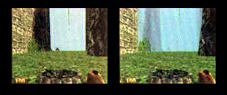
 In alot of games, when an object is further than the front plan, arriving in an X-distance (DEPTH), it is no longer rendered. This dissapearance may seem rather 'brutal', this is why the fuction of Fogging is often used, creating a sort of Myst or Fog in which the objects in the distance softly dissapear. Some games go even further and use this effect so they don't have to render anything but the objects that are closeby and thus speed up the game. For more realism this fog can be Volumetric, as it is the case in games like Quake III: Arena.
Lens Flare
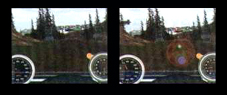 When looking at the sun through glasses or a window, you not only see a luminiscent point, but also a succession of luminiscent spots pointing in the direction of the source. In games like Flight Simulators and Car Simulators, this effect is very often used. Unfortunately, the programmers use and abuse this effect so often, that is becomes completely unrealistic because of the exageration.
Mip Mapping
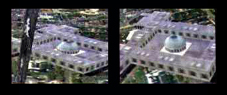 When approaching an object, it becomes disgracefull without Bilineair Filtering. But it becomes even more so when you zoom out. The size of the texture reduces more and more untill it reaches a point, where the objects become ugly. To avoid this problem, every texture is stocked in different sizes called Mip Maps (64x64, 32x32 and 16x16 pixels for example). This effect is almost invisible on the screenshots, since a 'textureswitch' is difficult to reproduce in a fixed image.
Multi-Texturing
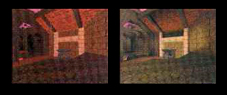 To obtain more realism, we can apply several textures (two in general) on one polygon. In theory we need twice the amount of time to calculate the 3Dscene. Fortunately, the latest 3D cards support two units of texturespace working at the same time. The use of two textures on one pixel happens in one cycle. Some games like Unreal use up to 5 textures at the same time.
Shadows
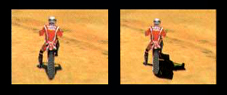 Like in reality is it possible to attribute a shadow on an object. There are several methods though. The first consists of placing a shadow underneath an object...without thinking of the different sources of light. More realistic is Volumetric Shadow keeping the lightsources in mind and bringing besides realism, important information towards the gamer. In a Quake-like as Unreal, with Volumetric Shadows on, its possible to find an enemy just by tracking it's Volumetric Shadow!
Shading
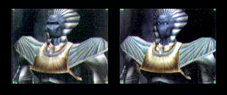 The value of the color of a polygon, depends off course on it's shadows. There are 3 actual methods. Flat Shading is the easiest method, because only one value is associated with a polygon. But with this method, the facets of an object are clearly visible. This is why the Gouraud Shading is most often used. The value of a color is comported by the sum of the polygons and from there the rest of the points of the polygon are calculated via interpolation. Thus the object appears more 'smooth'. Phong Shadows, comport a color value for every point.
Texturage
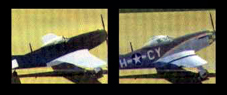 When created, an object only consists of polygons in one single color per polygon.
To achieve a realistic effect, textures are applied to the polygons. It simply consists of applying a single 2D image (texture) on a 3D object. This gives the possibility of changing a simple cube in a building for example, by using a texture of a wall with windows and doors, etc..
When created, an object only consists of polygons in one single color per polygon.
To achieve a realistic effect, textures are applied to the polygons. It simply consists of applying a single 2D image (texture) on a 3D object. This gives the possibility of changing a simple cube in a building for example, by using a texture of a wall with windows and doors, etc..
Trilineair Filtering
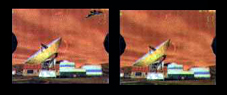 The problem of Mip Mapping is that when changing from one Mip Map to another, this happens apbrubtly or in a light 'flash'. To avoid this problem, Trilineair Filtering is used. This function works a bit like Bilineair Filtering, but this time each pixel is not only mixed with the 4 adjacent pixels, but also with the 4 adjacent pixels of the next Mip Map. this results in a softer transition between the different Mip Maps. Recent 3D Cards offer this effect without any notable loss of speed.
Z-Buffer 32-BITS
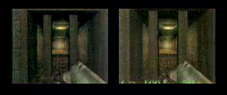 The Z-Buffer is a memory space which stocks the values of the depth (Z) of every pixel.
Thanks to this value it is possible to define which objects are or are not visible onscreen. Most games use a Z-Buffer of 16-BIT or 65.536 colors of depth per color. For an optimal quality, a Z-Buffer of 32-BITS will be better adjusted. In Quake III for example, using a 16-BIT Z-Buffer sometimes results in the dissapearance of lightsources in the distance, just by moving a few centimeters, while the light would still be present in 32-BIT.
The Z-Buffer is a memory space which stocks the values of the depth (Z) of every pixel.
Thanks to this value it is possible to define which objects are or are not visible onscreen. Most games use a Z-Buffer of 16-BIT or 65.536 colors of depth per color. For an optimal quality, a Z-Buffer of 32-BITS will be better adjusted. In Quake III for example, using a 16-BIT Z-Buffer sometimes results in the dissapearance of lightsources in the distance, just by moving a few centimeters, while the light would still be present in 32-BIT.